
Annual trend reports read like fashion editorials, predicting what will dominate social media feeds before the year has truly begun. We see something different at the bench.
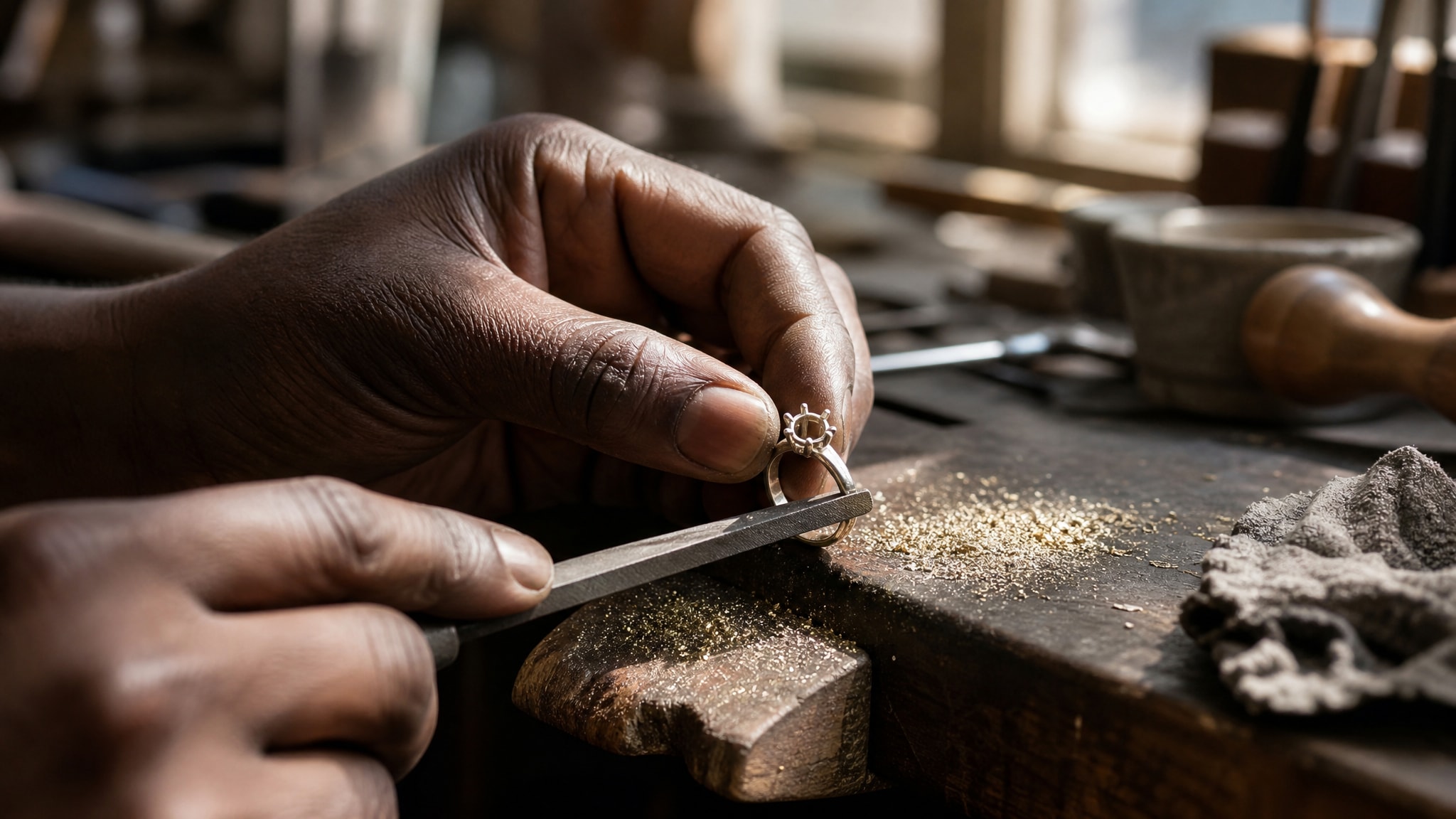
True engagement ring trends 2026 are defined by longevity and personal resonance, not seasonal novelty, because an engagement ring must endure decades of daily wear. Our Johannesburg atelier hand-finishes every setting at the bench, which lets us watch client preferences shift in real time, long before those shifts appear in retail reports. What emerges from these private consultations is not a uniform aesthetic but a collection of individual choices that prioritize meaning over momentary visibility.
Beyond the Listicle: Real Commissions Over Retail Forecasts
Genuine 2026 engagement ring trends set themselves apart from generic fashion forecasts by originating in private conversation rather than public performance. Mass-market predictions flatten nuance into digestible categories. The requests we receive in our atelier resist that simplification, because each couple brings its own history and values to the design table. You are not choosing from a pre-approved menu of acceptable styles when you commission a bespoke piece. You are articulating a vision that may have no precedent in current retail inventory.
This distinction matters because an engagement ring works differently than seasonal accessories or ready-to-wear fashion. A forecast might correctly predict which metal tones will dominate commercial displays next quarter, but it cannot account for the specific way a client's grandmother's art deco brooch should inform the milgrain detailing on a new platinum band. We find that the most enduring designs emerge when clients feel free to ignore prevailing winds entirely, trusting instead in the quiet authority of their own narrative and the technical guidance of a jeweller who knows how to translate emotion into metal.
Retail forecasting serves manufacturers who need to produce volume. Bespoke observation serves individuals who need to create significance.
Popular Engagement Ring Styles 2026: The Return of Intimacy
Popular engagement ring styles 2026 mark a shift away from maximalism toward designs that prioritize personal meaning and wearability over sheer carat weight or visual volume. Clients ask for subtle refinements and hand-finished details that reflect their own relationship, not social media aesthetics; they choose tactile quality over photographic impact. This does not mean beauty has diminished. It means beauty has moved from the external gaze to the intimate experience of the wearer.
You will notice this intimacy in the growing demand for lower-profile settings that sit flush against the finger, letting the ring move with the hand rather than announce itself across a room. Hand-finishing at the bench lets us soften interior edges and refine prong placement in ways mass production cannot replicate, so the piece feels considered against the skin through decades of daily life. The luxury is in knowing that human hands attuned to your specific comfort have touched every surface, not in owning an object built mainly to be admired from a distance.
We have noticed that couples now spend more time discussing how a ring will feel during ordinary moments than how it will photograph during extraordinary ones.
Trending Diamond Cuts and Modern Engagement Ring Design
Trending diamond cuts and modern engagement ring design get judged increasingly on light performance and individual character rather than shape popularity alone. Elongated silhouettes like ovals and marquises still matter, but 2026 commissions show a clear preference for stones chosen for their own optical personality and GIA certification integrity. A stone might have perfect proportions on paper yet lack the fire or scintillation pattern that speaks to a specific client's sensibility. That is why we evaluate each diamond in person rather than relying only on laboratory reports.
Every centre stone in our bespoke commissions is independently graded by GIA. This keeps quality verifiable even as aesthetic trends shift around it. Independent verification gives subjective aesthetic preferences a stable foundation to rest on, because you deserve certainty about what you are acquiring even as you exercise freedom in how it appears. Modern engagement ring design becomes a dialogue between measurable excellence and personal taste, and neither side gives ground to the other.
Selecting a diamond for its optical personality takes a patience that algorithmic matching cannot offer.
New Diamond Ring Trends: Bespoke Narratives and Heirloom Integration
New diamond ring trends now often involve working family heirlooms, or existing stones, into contemporary settings, satisfying both sustainability values and emotional resonance. Recent private consultations at our bench have shown more requests to redesign inherited stones into modern engagement ring designs, a move we read as sentimental sustainability: honoring lineage without copying historical aesthetics. Merging old materials with modern engagement ring design takes real craftsmanship, because vintage stones often carry proportions, inclusions, or wear patterns that call for respectful adaptation rather than forcing them into current templates.
You bring more than gemstones to this process when you choose heirloom diamond redesign. You bring generations of accumulated meaning that deserve preservation alongside transformation. Our bench work lets us assess each inherited stone's structural integrity and optical potential on its own terms, and decide whether it should be reset as-is, recut for better performance, or worked in as an accent within a new composition. The resulting piece carries familial continuity forward while asserting its own contemporary identity, favoring genuine synthesis over pastiche.
Repurposing existing stones demands technical honesty about what can, and cannot, be achieved without compromising the material's integrity.
Engagement Ring Shapes 2026: Proportion and Personal Geometry
Engagement ring shapes 2026 work not as isolated silhouettes but as elements of hand proportion and lifestyle compatibility, and need assessing beyond any static trend list. Our bench work looks at how specific shapes interact with the wearer's hand anatomy: a radiant cut may sit beautifully on longer fingers while overwhelming shorter ones, and a pear shape's orientation affects both visual elongation and comfort during manual tasks. You deserve a fitting process that treats your hand as a three-dimensional form in motion, not a two-dimensional canvas for displaying fashionable geometry.
This personal approach extends to how daily activities shape long-term satisfaction with a chosen design. Someone who works extensively with their hands may need different bezel configurations or crown heights than someone at a desk all day, whatever silhouette currently leads the editorial coverage. Through our bespoke fine jewellery process, we prototype and adjust until the ring sits in harmony with both your anatomy and your daily life, so aesthetic appeal never costs you functional ease.
Proportion is relational, not absolute. It has to be discovered through direct observation, not prescribed by generalization.
The Foundation of Trust: GIA Certification in an Evolving Market
Whatever engagement ring trends 2026 brings, the demand for independently verified quality stays constant among buyers who understand that aesthetic preferences evolve while material value endures. GIA certification stays essential despite changing tastes, because it gives objective documentation that outlasts subjective preference and protects your investment against market shifts and future reassessment. Our GIA certified diamonds guide explains how independent grading sets a baseline of confidence before any design decisions begin.
This verification matters especially when working through engagement ring pricing in Johannesburg, where transparent valuation depends on standardized assessment rather than a seller's word. Trends will keep cycling through favor and obsolescence, but the documented characteristics of your centre stone stay fixed points of reference, enabling informed decisions today and fair transactions tomorrow. We hold this standard not because tradition demands it, but because trust needs evidence that survives past the moment of purchase.
Certification protects the buyer long after the initial excitement of acquisition has settled into quiet ownership.