
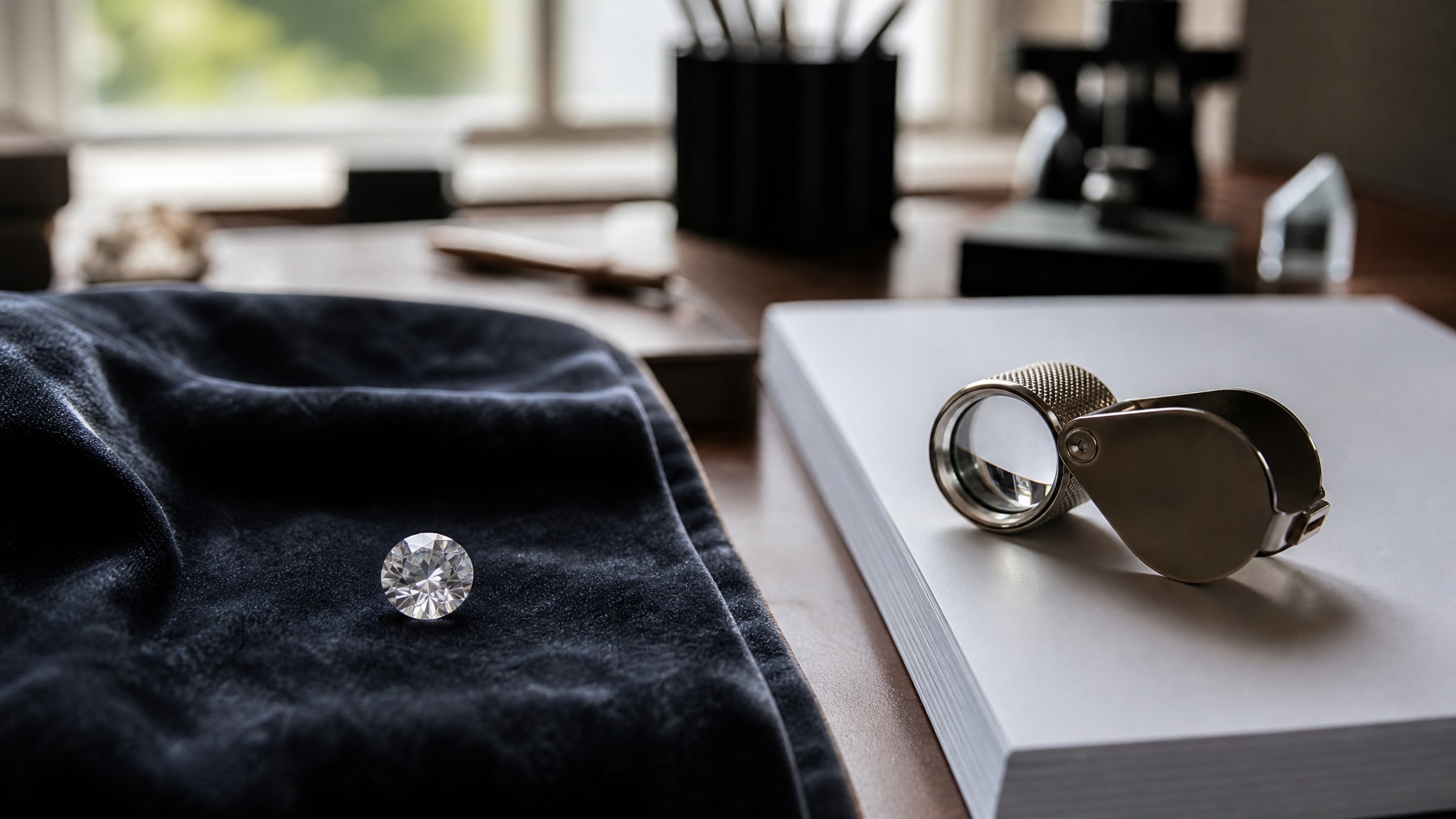
Choosing an engagement ring is one of the most significant investments you will make, yet the process often feels overwhelmed by technical jargon and impersonal retail environments. We believe that learning how to choose an engagement ring diamond should be a journey of education and discovery, not a high-pressure transaction. At De Melo Diamonds, we have structured our private atelier to slow this process down, so you can focus on beauty, provenance and craftsmanship instead of navigating a confusing sales floor. This guide reflects our philosophy as a founder-led house: that true value lies in certified quality, honest guidance, and a relationship that extends far beyond the moment you say yes.
Why Independent GIA Certification Matters More Than Brand Name
Every centre diamond we offer is independently graded by the Gemological Institute of America (GIA). That grading is separate from any retail incentive, so it gives you an objective read on what you're actually buying. When you are learning how to pick a diamond in South Africa, this distinction is the bedrock of your purchase, because it removes any ambiguity about the stone itself. A retailer's in-house certificate or a generic appraisal may serve insurance purposes, but it does not give you the universal benchmark you need to compare natural diamonds across sellers, or to judge fair market value. You deserve a baseline that exists outside the shop where the transaction takes place.
Reading a GIA Report Beyond the 4Cs
A grading report is more than a list of specifications. It is a fingerprint of the stone's character and its optical potential. The 4Cs of diamonds, as most guides explain them, give you a necessary vocabulary, but they rarely capture the proportions, fluorescence or inclusion placement that decide whether a stone feels alive or merely adequate. For deeper technical context, our article on understanding GIA certification in Johannesburg explores how to read these reports with confidence. We review every certificate ourselves before presenting a stone, to be sure its paper grade translates into real brilliance in person.
The Difference Between Lab Grading and Retail Appraisal
Laboratory grading assesses intrinsic quality under controlled conditions. Retail appraisals, by contrast, often reflect replacement cost inflated for insurance margins. Confusing the two is a common pitfall, and it can mean overpaying for inferior quality or misunderstanding the asset you actually hold. GIA is the most widely recognized and consistent diamond grading laboratory in the world, and its reports are treated as the definitive benchmark in both trade and insurance contexts. That consistency protects your investment long after the initial excitement fades: it's a permanent record of quality that travels with the stone regardless of future valuations or resale.
Understanding Diamond Carat vs Cut for True Brilliance
Carat weight measures mass, not visual size. Chasing it above all else frequently produces stones that look smaller, and perform worse, than lighter alternatives. This is perhaps the most important idea in any diamond quality guide, and the least understood by buyers used to equating bigger numbers with better rings. We encourage you to shift focus from arbitrary weight milestones to optical performance, because a diamond's whole purpose is to interact with light. Your budget is better spent on cutting precision than on hidden weight that adds nothing to how the ring reads on your hand.
Why Cut Quality Dictates Light Performance
Cut is the only human contribution to a diamond's beauty. It governs how effectively light enters the stone, reflects, and returns to the eye as fire and scintillation. A well-cut 0.90ct round brilliant often faces up larger and sparkles more intensely than a poorly cut 1.00ct stone, which is exactly why optical performance outweighs nominal weight. When we discuss carat versus cut in consultations, we use physical comparisons to show how a shallow or deep cut leaks light and leaves dead zones that no amount of carat weight can fix. You will see immediately that the most impressive stone on the tray is not always the heaviest one.
Balancing Carat Weight with Visual Size
Intelligent selection means finding the point where millimetre spread maximizes face-up size without giving up structural integrity or brilliance. Certain weight thresholds carry a disproportionate price premium, purely on market psychology, so a stone just below a "magic number" can offer noticeably better value per unit of visible beauty. We help you find these openings by focusing on measurements and cut grades rather than chasing round numbers that inflate cost without improving how the ring wears. The result respects both your taste and your budget: a ring that looks exceptional rather than merely expensive.
Selecting the Best Diamond Shape for Engagement Ring Designs
Shape is deeply personal, and it should follow from hand anatomy, lifestyle and the design language of your setting, not from trend cycles alone. Finding the best diamond shape for your engagement ring means watching how different silhouettes interact with finger proportion and skin tone, in real time. We don't rely on generic shape charts, because a silhouette that photographs beautifully online can feel cumbersome or unbalanced worn every day. You need to understand how geometry becomes comfort and wearability before committing to a form that will define your hand for decades.
Classic Rounds vs. Fancy Shapes for Hand-Finished Settings
Round brilliants offer unmatched versatility and light return, which makes them reliable for solitaires and halos alike. Fancy shapes bring a different character, one that suits bespoke design work particularly well. Emerald and asscher cuts demand higher clarity, because their open facets show inclusions more readily, while ovals and pears need careful symmetry checks to avoid the bow-tie effect that dulls their elegance. Our bench artisans weigh these variables as they design each setting, so prong placement and metalwork enhance the stone's geometry rather than fight it. This integration of stone selection and fabrication is something mass production can't replicate.
How Finger Proportion Influences Shape Choice
Longer fingers can carry elongated shapes, like marquise or radiant cuts, gracefully. Shorter fingers often suit round or cushion silhouettes better, since they create a more balanced visual weight. Width matters too: a broad band or a substantial setting can overwhelm a delicate hand unless the centre stone's dimensions are scaled to match. During consultation, we watch how different shapes sit against your specific hand and adjust our recommendations from there. That tactile assessment is what makes the final piece feel like an extension of you, rather than something placed on top of you.
Navigating Clarity and Colour Without Overpaying
Chasing flawless clarity and D-colour grades often means paying a real premium for qualities invisible to the unaided eye. It doesn't make the ring more beautiful in daily wear, and it eats into budget that could go toward cut quality or setting craftsmanship instead. Our role is to find the value zones where savings don't cost you visible impact, so your money goes toward what actually matters once the ring is on your hand. Perfection on paper is not the same thing as perfection in life.
Eye-clean SI1 or VS2 clarity typically looks identical to VVS once set, provided the inclusions sit away from the table and aren't reflected through multiple facets. Near-colourless G-H-I grades face up white in platinum or white gold, too, and cost considerably less than colourless stones. We build our inventory around these practical thresholds: we reject stones with problematic inclusions regardless of grade, and we're happy to embrace imperfections that a good design hides safely. That discernment is how we present options that maximize brilliance within your budget, rather than pushing you toward upgrades you don't need.
How to Pick a Diamond in South Africa: Local Nuances
Buying diamonds in Johannesburg has real advantages, but it also asks for vigilance around sourcing transparency and verification that can differ from international markets. Learning how to pick a diamond in South Africa means understanding that local availability varies, and that imported stones can carry different pricing dynamics than domestically sourced material. You should expect full disclosure on origin, treatment history and supply chain documentation from any reputable seller here. Trust is earned through transparency. It is never assumed on the strength of geography alone.
Sourcing Ethically Within the Local Market
South Africa's diamond industry carries historical weight and a real contemporary responsibility, which makes ethical verification non-negotiable for a conscientious buyer. We maintain direct relationships with suppliers who follow Kimberley Process standards and provide traceability documentation for every stone we present. That commitment means your symbol of love doesn't carry hidden costs, human or environmental. Asking pointed questions about provenance isn't rude. It's the due diligence that separates a responsible jeweller from an opportunistic trader.
The Value of Face-to-Face Stone Viewing
Photographs and video can't convey the interplay of light, shadow and colour that gives a diamond its living presence. Viewing certified natural diamonds in person, under varied lighting at our private atelier, reveals things a screen flattens or distorts. You need to see how a stone behaves in daylight, in warm interior light and in dim evening ambience, before you understand its real personality. That sensory evaluation can't be replaced, and it's the foundation of a confident decision in an age dominated by online imagery.
From Selection to Setting: The Bespoke Advantage
Choosing a diamond can't really be separated from designing its home. Treating the two as sequential steps, rather than one integrated decision, tends to weaken the final result. We have chosen to remain deliberately small and intimate, hand-finishing every setting at our own bench so we keep direct oversight of how each diamond performs once it's mounted. That unity of selection and fabrication means the stone's own character shapes every part of the setting's architecture. What you get is a cohesive creation, not a component bolted together from disconnected sources.
Matching Stone Character to Metal and Design
Metal choice shapes perceived colour temperature, and setting style affects both security and light exposure. A warm-toned gold can flatter a lower-colour diamond by masking a faint yellow tint, while platinum's cool neutrality asks for a higher colour grade to keep the harmony. Our piece on bespoke fine jewellery craftsmanship goes into how these considerations shape our process, from the first sketch to the final polish. Each decision serves the stone's own nature, rather than forcing a template onto different materials.
Building a Relationship Beyond the Purchase
An engagement ring is the start of a lifelong association with the jeweller who made it: maintenance, resizing, cleaning, and eventually, heirloom transitions. We treat every consultation as the first conversation in an ongoing relationship, built on mutual respect and shared standards. Clients who return years later for handcrafted wedding bands made at the bench, or for anniversary pieces, already know our work and our attention to detail. That continuity is peace of mind an anonymous retailer can't offer, because accountability sits with people, not policies.
Preparing for Your Private Diamond Consultation
Arriving prepared turns your consultation from a browsing session into a focused collaboration, one that respects both your time and ours. Gather inspiration images, settle on a realistic budget, and talk through your partner's preferences beforehand, and we can curate a selection built around your actual vision. If you're unsure what to expect, our guide on what to expect in a private consultation walks through the experience in detail, so you can arrive with confidence. Preparation shows us you're serious, and it lets us give your situation our full attention.
Bring reference photos that capture mood and proportion rather than exact replicas; bespoke work interprets, it doesn't duplicate. Be honest about your budget. That information helps us find creative solutions within your range, instead of showing you stones that distract from what's actually achievable. Think about practical things too: which hand you wear rings on, wear concerns tied to your profession, existing jewellery the new piece needs to sit alongside. These details matter, because the goal is something beautiful that also works in your actual life.
This approach to diamond selection isn't built for the fastest transaction or the lowest price on the market. It suits people who value education, craftsmanship and personal attention over convenience and volume. If that sounds like how you want to mark this milestone, we invite you to book a private consultation at our Johannesburg atelier. There, in quiet and without hurry, you can begin choosing a diamond that truly belongs to your story.